medAge Biltmore Park · Suite 218, Asheville NC · Call 828-684-1212 | Financing Available — 0% APR options through PatientFi

Is Filler Safe? An Honest Look at the Risks and How to Choose a Safe Injector
Medically reviewed by Sarah Long, DNP, APRN, FNP-BC — Clinical Lead, medAge  •  Updated June 2026

Dermal filler is one of the most popular aesthetic treatments in the world, and for the vast majority of people it’s safe and uneventful. But if you’ve spent any time online, you’ve also seen the frightening stories. Rather than pretend risks don’t exist, we’d rather do what a good medical practice should: tell you honestly what they are, how they’re minimized, and how to choose a provider who keeps you safe.

The short answer: Serious complications from filler are rare, but they’re not zero — and the single biggest factor in your safety is who is holding the syringe. An experienced, anatomy-trained injector working in a prepared medical setting dramatically lowers your risk.

The risk that matters most: vascular occlusion

Most filler side effects are minor and temporary — swelling, bruising, tenderness. The one serious complication worth understanding is vascular occlusion: this happens when filler is accidentally placed into or presses on a blood vessel, interrupting blood flow to the surrounding tissue. Left unaddressed, it can lead to skin damage and, very rarely, more serious outcomes.

How common is it? Rare. Large studies place the risk of serious vascular complications well under 1% of treatments, with some estimates far lower. But because it’s a genuine medical emergency when it does occur, it deserves respect — and preparation.

Why experience and anatomy are everything

Vascular occlusion isn’t random bad luck; it’s closely tied to injector skill. The face has “danger zones” — areas like around the nose, the glabella (between the brows), and the nasolabial folds — where blood vessels run in predictable but unforgiving places. A well-trained injector knows this anatomy in detail, uses careful low-pressure technique, and — just as importantly — knows when not to inject. The evidence is consistent on this point: risk drops substantially in experienced, properly trained hands.

This is exactly why the “who” matters more than the “where you got a deal.” A rushed injection from someone without deep anatomical training is where risk concentrates.

What a prepared practice looks like

Good injectors don’t just aim to avoid complications — they’re ready for the rare one. In a properly run medical practice, that means:

  • An injector with medical training and thorough knowledge of facial anatomy
  • A written emergency protocol for recognizing and managing a vascular event immediately
  • Reversal medication kept on hand — for hyaluronic acid fillers, an enzyme called hyaluronidase can dissolve the product in an emergency
  • Time taken for a real consultation, medical history, and honest discussion of your candidacy
  • Clear follow-up and a way to reach the practice quickly if something feels off

These aren’t luxuries; they’re the baseline of safe care. It’s a fair thing to ask any provider about before you book.

Know the early signs. After filler, contact your provider right away if you notice unusual or worsening pain, skin that turns white/blanched or dusky and mottled, or any changes in vision. Prompt action makes an enormous difference in outcomes — so never “wait and see” with symptoms like these. When in doubt, call.

How to choose a safe injector

You don’t need to be an expert to protect yourself — you just need to ask a few good questions:

  • Are you a licensed medical professional, and who is the supervising physician?
  • How much experience do you have with this specific treatment and area?
  • What’s your protocol if a vascular complication happens — and do you keep reversal medication on site?
  • Can we talk through my options and risks before anything is decided?

A confident, experienced provider will welcome these questions. Anyone who brushes them off is telling you something important.

Important: This article is general education, not medical advice, and it can’t diagnose or treat any individual situation. Good technique lowers risk but cannot eliminate it entirely. If you’ve had filler and are experiencing concerning symptoms, contact your provider or seek medical care promptly.

The bottom line

Filler is safe for most people most of the time — and it’s safest in the hands of a trained medical injector working in a practice built for it. That’s the standard we hold ourselves to, and it’s the standard you deserve wherever you go.

Frequently asked questions

Is dermal filler safe?

For most people, yes. The majority of side effects are minor and temporary, like swelling or bruising. Serious complications are rare — well under 1% of treatments — and are minimized most by choosing an experienced, medically trained injector in a prepared setting.

What is vascular occlusion?

It’s the serious but rare complication where filler blocks or compresses a blood vessel, interrupting blood flow to nearby tissue. It’s a medical emergency that requires prompt recognition and treatment, which is why injector experience and practice preparedness matter so much.

How do I choose a safe filler injector?

Look for a licensed medical professional with strong knowledge of facial anatomy, real experience with your specific treatment, a clear emergency protocol, and reversal medication kept on site. A good provider will happily answer these questions.

Want to meet a medical team that treats safety as the standard, not an afterthought? We’d be glad to talk through your goals at a consultation.
Meet the medAge medical team →

Collagen Banking: The Honest Version of the Trend

Medically reviewed by Sarah Long, DNP, APRN, FNP-BC — Clinical Lead, medAge  •  Updated June 2026

“Collagen banking” is everywhere right now — the idea that treating your skin in your 20s, 30s, and 40s lets you build up a reserve of collagen to draw on as you age. There’s a real, sensible idea underneath it. There’s also a fair amount of marketing gloss. Here’s the honest version.

The short answer: Collagen banking is a preventative mindset — supporting your skin’s collagen production before significant loss shows up, so you age from a stronger starting point. The biological rationale is sound, but it isn’t a literal savings account, and it’s not a substitute for the basics. Think of it as one sensible layer, not a magic strategy.

What “collagen banking” actually means

Despite the name, you’re not depositing collagen to withdraw later. What the term really describes is being proactive: gently encouraging your skin to keep producing collagen during the years when it does so most readily, rather than waiting until deep lines and laxity have already set in.

The premise behind it is real. Commonly cited estimates suggest we begin losing roughly 1% of our collagen each year starting in our mid-20s. Since collagen is what keeps skin firm and smooth, the logic goes: support production early, and you’re working from a stronger baseline down the road.

What’s genuinely supported — and what’s still marketing

The real partCollagen does decline with age. Your fibroblasts — the cells that make collagen — respond to stimulation, and both biostimulatory injectables like calcium hydroxylapatite (Radiesse) and energy treatments like Ultherapy are shown to prompt new collagen. Starting from a healthier baseline is a reasonable, intuitive goal.
The overstated partNo one can promise you’re “banking” decades of youth. The best timing to start, and the long-term payoff of treating very early, are still an evolving area of clinical study — not settled science. Results vary, and more treatment isn’t automatically better.

How collagen banking actually gets done

If the goal is to support collagen production, there’s more than one way to do it — and the tools work through genuinely different mechanisms, which is the kind of detail worth understanding:

Biostimulator injectables — like calcium hydroxylapatite (Radiesse) — place a material into the skin that acts as a scaffold, prompting your fibroblasts to build new collagen around it over time.

Ultherapy takes an energy-based route with no injection at all. It uses microfocused ultrasound to gently heat precise points deep in the skin, creating tiny areas that switch on your body’s natural repair response. Histology studies show this prompts new collagen and — notably — new elastin, the fiber responsible for skin’s springiness, which not every treatment stimulates. Ultherapy is FDA-cleared for lifting and tightening the brow, neck, under-chin, and décolletage.

Because these approaches work differently, they’re sometimes used together — but neither one replaces the foundation below.

The foundation nobody should skip

Here’s the part the trend pieces tend to gloss over: the single most effective, best-proven collagen-protection strategy isn’t an injectable at all. It’s daily sun protection and a solid skincare routine. The American Academy of Dermatology points to daily sun protection as a cornerstone of preventing premature aging, and ingredients like retinoids and vitamin C have real evidence behind them.

If your skin is holding up well, a great SPF and a consistent home regimen may be the smartest “banking” plan for now. Biostimulators are a layer you can add on top of those habits — never a replacement for them.

So should you start?

Maybe — but it should be a personalized decision, not a reaction to a trend or a fear of aging. A thoughtful approach is conservative: the right foundation first, then a measured discussion about whether a biostimulator makes sense for your skin, your age, and your goals. There’s no prize for starting earliest, and the best plan is the one built specifically for you.

A fair note on the science: “Collagen banking” is a consumer term, not an official clinical claim from any manufacturer — the real, supported science underneath it is that these treatments stimulate collagen (and, with Ultherapy, elastin). Using biostimulators or Ultherapy purely preventatively in younger skin extends that mechanism beyond their specific FDA-cleared uses (which center on lifting, tightening, and correction). The rationale is reasonable, but long-term preventative outcomes are still being studied. This is a personalized clinical decision, not a guaranteed result — and it’s one we’re happy to talk through honestly.

The takeaway

Collagen banking isn’t a gimmick, but it isn’t a miracle either. Treat it as what it is: a sensible, preventative mindset that starts with sunscreen and skincare, and may include a well-chosen biostimulator when the timing is right for you. We’d rather give you that honest framing than sell you a trend.

Frequently asked questions

At what age should I start collagen banking?

There’s no single “right” age. Many people begin thinking about it in their late 20s to 40s, but the honest answer is that it depends on your skin, habits, and goals. The foundation — sun protection and skincare — is worth starting at any age; injectables are a personalized decision.

Does collagen banking really work?

The rationale is sound: collagen declines with age, and biostimulators can prompt new collagen production. But no treatment “stores” youth for later, and long-term preventative outcomes are still being studied. It’s best viewed as proactive maintenance, not a guarantee.

Is preventative Botox the same as collagen banking?

Not quite. Preventative neurotoxin aims to soften expression lines before they set in, while collagen banking focuses on supporting the skin’s structural collagen. They’re different tools that can be part of the same overall preventative plan.

Does Ultherapy help with collagen banking?

Ultherapy stimulates new collagen and elastin using microfocused ultrasound — a legitimate, well-studied mechanism — so it fits the collagen-banking idea of supporting your skin’s own production. It’s FDA-cleared for lifting and tightening; its use as a purely preventative tool is a personalized decision, and results build gradually over months.

Want an honest, no-pressure conversation about whether preventative treatment makes sense for you? That’s exactly what a consultation is for.

Explore biostimulators at medAge →

Can Radiesse Tighten Skin? How One Filler Does Both Lift and Skin Quality

Medically reviewed by Sarah Long, DNP, APRN, FNP-BC — Clinical Lead, medAge  •  Updated June 2026

Most people think of Radiesse as a filler for adding structure — a firmer jawline, more defined cheeks. But one of its most useful qualities rarely gets explained: depending on how it’s prepared, the very same product can be used to improve skin quality and firmness across broad, delicate areas like the neck, chest, and hands.

The short answer: Yes — when diluted, Radiesse can be used to help tighten and smooth crepey skin, not just add volume. Adjusting how thick or thin the product is changes what it does in the skin, which is why a single filler can serve very different purposes in skilled hands.

The thing most people don’t know: Radiesse is adjustable

Radiesse is made of calcium microspheres suspended in a gel. That gel can be mixed with additional sterile fluid before treatment — a step your injector controls. How much fluid is added changes the consistency of what’s placed in your skin, and that consistency determines the job it’s best suited for.

Think of it a little like the difference between frosting and glaze made from the same base. Thicker and firmer holds a shape and lifts. Thinner and more spreadable coats a wider surface and refines texture. It’s the same idea here.

What changes when Radiesse is diluted

In its standard form, Radiesse is firmer and holds its position — ideal for adding lift and definition where you want structure, like the jawline (an FDA-approved use) or cheeks. When it’s diluted, it becomes thinner and spreads more evenly through a layer of skin, where the goal shifts from “add volume here” to “improve the quality of the skin overall” — stimulating collagen across a broader area to firm and smooth.

Standard RadiesseFirmer consistency. Used for structural lift and contour — jawline, cheeks, definition. Holds its shape where placed.
Diluted / hyperdilute RadiesseThinner, spreadable. Used to improve skin quality and firmness across areas like the neck, chest, and hands — smoothing crepey texture.

Where diluted Radiesse tends to shine

The diluted approach has become a well-recognized technique for skin-quality concerns that traditional filler doesn’t address well — the kind of thin, crepey laxity that shows up on the neck, the décolletage (chest), and the backs of the hands. Rather than plumping a single line, it works to firm and refresh the whole surface over time as your own collagen responds. There are published expert consensus guidelines specifically covering the use of diluted and hyperdiluted calcium hydroxylapatite for these skin-tightening purposes.

Why this matters for you

The practical upside is versatility. Instead of needing a different product for every concern, a single, well-understood biostimulator can be tailored to the job — structure where you want it, skin refinement where you need it. For your provider, that means the plan is built around your anatomy rather than around what’s in the drawer.

Important context: Diluting Radiesse for skin-quality and skin-tightening purposes is a technique used at your provider’s discretion and falls outside Radiesse’s specific FDA-approved uses. It’s supported by published expert consensus and clinical experience, but the science on exactly how diluted formulations behave is still an area of active discussion. Results build gradually and vary from person to person — this is a tailored clinical decision, not a guaranteed outcome, and it’s made together at consultation.

The takeaway

If you’ve been told filler couldn’t help crepey skin on your neck or chest, it’s worth a second conversation. The answer may not be more volume — it may be the same trusted product, prepared differently.

Frequently asked questions

Can Radiesse tighten skin on the neck and chest?

Diluted Radiesse is commonly used as a technique to improve skin firmness and crepey texture on the neck, chest, and hands by stimulating your own collagen. It’s an off-label use supported by expert consensus; results develop gradually and vary by person.

Is hyperdilute Radiesse the same product as regular Radiesse?

Yes — it’s the same Radiesse, mixed with additional sterile fluid before treatment so it spreads more thinly through the skin. The dilution changes how it behaves, shifting the focus from structural lift toward overall skin quality.

How soon will I see results?

Because these effects rely on your body producing new collagen, improvement builds over weeks to months rather than appearing instantly. Your provider will set realistic expectations based on the area treated and your skin.

Wondering whether Radiesse could help your skin quality — not just add volume? Let’s talk it through at a complimentary consultation.

Explore Radiesse at medAge →

The “Naked” Neurotoxin: What’s Actually in Your Wrinkle Treatment

Medically reviewed by Sarah Long, DNP, APRN, FNP-BC — Clinical Lead, medAge  •  Updated May 2026

Most people think of neurotoxin as a single thing — “Botox.” But there are several brands on the U.S. market, and they aren’t identical. The real differences aren’t in the active ingredient; they’re in what’s packaged alongside it. Here’s what’s actually in the vial.

None of this requires a science degree to follow, and knowing it helps you understand why we made the choice we did.

The active ingredient is the same idea across all brands

Every botulinum toxin type A product works using the same core molecule — a purified protein, about 150 kilodaltons in size, that temporarily quiets the signal between nerve and muscle so the muscle relaxes and the overlying wrinkle softens. That core is the part doing the work in every brand, from Botox to Dysport to Xeomin.

So if the working molecule is essentially the same, where do the brands actually differ? In the company each molecule keeps.

The “extras” — and where they come from

In nature, the botulinum molecule travels wrapped in a bundle of accessory proteins called complexing proteins. They exist to protect the toxin in the harsh environment of the digestive tract. That’s a genuinely useful function — if you were swallowing it. But you’re not. It’s being injected into muscle, where those complexing proteins serve no purpose at all.

In fact, once the product is reconstituted for injection, the great majority of those complexing proteins simply detach from the active core and drift off, contributing nothing to your result. Depending on the brand, a vial may also carry other leftovers of the manufacturing process — bacterial remnants, or in some products a lab-added peptide. None of it makes your treatment work better.

Why “extra” isn’t harmless

Here’s the part that matters. Those unnecessary proteins can act as a kind of flag to your immune system. The more foreign protein your body is exposed to over time, and the more often, the greater the chance it starts to recognize and react to it. For most people getting occasional cosmetic treatment, this is not a pressing concern — but for long-term or higher-dose users, a lighter protein load is a sensible thing to want. (We go deep on this in our companion article on why neurotoxin sometimes stops working.)

What makes Xeomin the “naked” toxin

Xeomin is manufactured differently. It goes through an additional purification — a double-filtration step the maker calls Xtract Technology — that removes the complexing proteins, leaving essentially just the active 150-kilodalton neurotoxin. It’s the only botulinum toxin approved in the U.S. that contains no complexing proteins and no virally-derived peptide additives, and it carries the lowest total protein load of the available toxins. That’s the reason it’s often described as the “naked” or “pure” toxin.

1
Start with the botulinum complex — the active core plus its natural bundle of accessory proteins.
2
Double-filter to strip away the complexing proteins that do nothing for an injected treatment.
3
What remains is essentially the pure active neurotoxin, plus two well-established, gentle stabilizers.

The two stabilizers left in the vial are human serum albumin — the most abundant protein in your own blood — and sucrose, a simple sugar. Both have long, well-understood safety records.

Does “purer” mean better results?

Not in the way people assume. In head-to-head studies, Xeomin’s effectiveness and how long it lasts are comparable to the other leading toxins — it is not stronger, and it won’t give you a dramatically different day-one result. Its advantage is subtractive: it’s about what’s left out, which is most relevant as a long-game strategy for people who plan to use neurotoxin for years. Because the products differ, units of one toxin can’t be directly swapped for another — dosing is always tailored by your injector.

Straight talk: Direct head-to-head studies proving that removing these proteins makes one brand less likely to cause resistance than another haven’t been done, so no manufacturer can claim outright superiority — and we won’t either. What we can say is that the composition is simpler, the purity is real and verifiable, and it’s the profile we prefer for our patients over the long run.

Why we chose it

We use Xeomin at medAge because, all else being comparable, we’d rather give you the working molecule and as little of the unnecessary extras as possible. It’s the same philosophy we bring to everything here — do the effective thing, skip what doesn’t earn its place.

Frequently asked questions

What’s the difference between Xeomin and Botox?

Both use the same active neurotoxin. The difference is purity: Xeomin is double-filtered to remove the complexing proteins that ride along in some other products, so it’s often called the “naked” toxin. Effectiveness and duration are comparable in head-to-head studies.

Is Xeomin as effective as Botox?

Yes. In head-to-head studies, Xeomin’s effectiveness and how long it lasts are comparable to the other leading neurotoxins. It isn’t stronger — its distinction is a simpler, purer composition, not a bigger result.

What’s actually in Xeomin?

Essentially the active 150-kilodalton neurotoxin plus two well-established stabilizers: human serum albumin (the most abundant protein in your blood) and sucrose. It contains no complexing proteins and no virally-derived peptide additives.

Curious whether Xeomin is right for you? Our injectors will build a plan around your goals — and your long-term results.

Learn about Xeomin at medAge →

Biostimulator vs. Regenerative: They’re Not the Same Thing

Medically reviewed by Sarah Long, DNP, APRN, FNP-BC — Clinical Lead, medAge  •  Updated May 2026

“Biostimulator.” “Regenerative.” “Collagen-building.” These words get used interchangeably in aesthetics marketing — but they don’t all mean the same thing. Understanding the difference will make you a sharper consumer, and it explains why we’re particular about the products we use.

This is a short, useful distinction that almost no clinic bothers to explain. Once you have it, a lot of the marketing you see online becomes easier to read.

What “biostimulation” actually means

Biostimulation simply means prompting your body to produce more of a specific biological building block — most often collagen. A biostimulatory treatment doesn’t just sit there adding volume; it signals your cells to get to work making something.

That’s genuinely valuable. But notice how narrow the definition is: stimulate the production of one component. By itself, that doesn’t say anything about whether the tissue is truly rebuilt or restored to how it functioned when it was younger. Stimulating collagen is a piece of the puzzle — not the whole picture.

What “regeneration” means — and why it’s a higher bar

Regeneration is a bigger idea borrowed from regenerative medicine. It means the actual repair and restoration of tissue so that it regains not just its structure but its function — behaving like healthy, younger tissue again.

Here’s the key logic, and it’s worth reading twice: something can be biostimulatory without being regenerative, but anything regenerative is, by definition, also biostimulatory. Stimulating collagen is one ingredient. Regeneration is the finished dish — collagen plus the other structures that make skin behave the way it did years ago.

Your skin is more than collagen

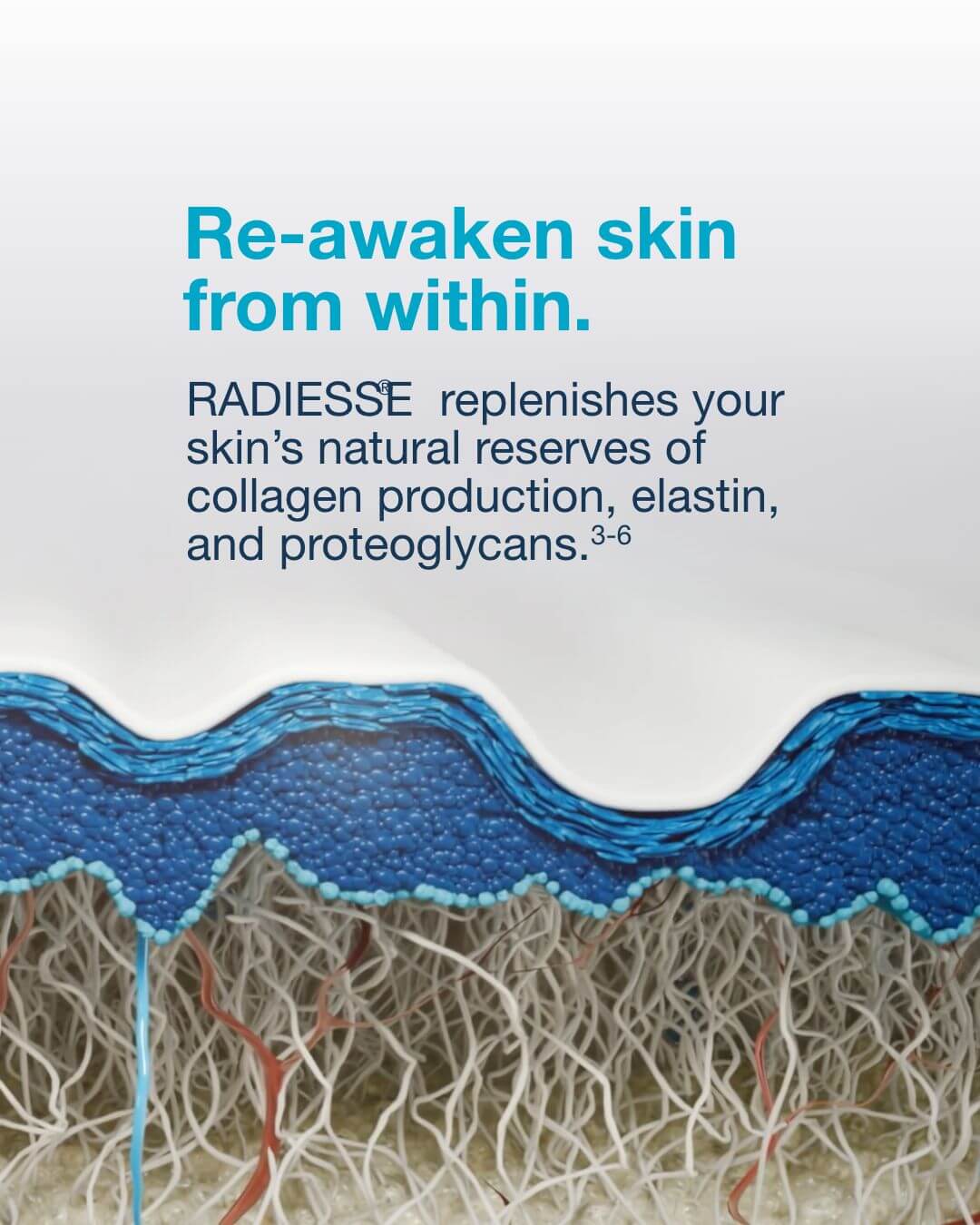
To understand why the distinction matters, it helps to know what actually gives youthful skin its quality. It isn’t collagen alone. Skin’s support system — the extracellular matrix — is a whole ecosystem:

CollagenThe scaffolding that gives skin structure and firmness.
ElastinThe springy fibers that let skin stretch and snap back.
ProteoglycansWater-binding molecules that keep skin hydrated and plump from within.
VasculatureThe tiny blood vessels that oxygenate and feed the skin.

As skin ages, all of these decline together — not just collagen. So a treatment that only nudges collagen is addressing one part of a much larger system. True regeneration means rebuilding across the ecosystem.

Where this lands for the products we use

This is exactly why we favor calcium hydroxylapatite (Radiesse) as a biostimulant. In peer-reviewed literature, Radiesse has been shown to do more than stimulate collagen — it acts as a scaffold that prompts increases in collagen, elastin, proteoglycans, blood vessels, and the fibroblast cells that build all of it. In other words, it works across that whole ecosystem, which is why it’s increasingly discussed under the banner of “regenerative aesthetics” rather than simply “a collagen stimulator.”

That’s not a knock on other biostimulators — many are excellent at what they do. It’s a distinction about scope: stimulating one component versus restoring the broader matrix. When the goal is genuine skin-quality improvement and not just a temporary plump, that broader scope is what we’re after.

A fair note on the science: “Regenerative aesthetics” is an emerging and still-developing field. Much of the supporting work consists of expert reviews and smaller studies rather than large long-term trials, and results vary from person to person. We find the evidence compelling and use it to guide our choices — not as a guarantee of any specific outcome.

The takeaway

When you see a treatment marketed as “collagen-building,” it’s fair to ask a follow-up: is it just stimulating collagen, or is it helping restore the whole support structure of your skin? That single question separates a lot of the noise from the substance — and it’s the kind of thing we’re always happy to walk through with you in person.

Frequently asked questions

What is a biostimulator?

A biostimulator is a treatment that prompts your body to produce more of a biological building block — usually collagen — rather than simply adding volume. Radiesse and Sculptra are two of the best-known injectable biostimulators.

Is Radiesse regenerative or just a biostimulator?

Peer-reviewed literature describes Radiesse as doing more than stimulating collagen — it prompts increases in collagen, elastin, proteoglycans, blood vessels, and fibroblasts, which is why it’s increasingly discussed within “regenerative aesthetics.” The field is still developing, so results vary by person.

What is regenerative aesthetics?

It’s an emerging approach that aims to restore youthful skin structure and function using the body’s own repair systems, rather than only filling lines. It’s a growing area of research, though much of the evidence is still early.

Want to understand which approach fits your skin and your goals? Let’s talk it through at a complimentary consultation.

Explore biostimulators at medAge →

“Why Did My Botox Stop Working?” Tolerance, Resistance, and What You Can Do About It

Medically reviewed by Sarah Long, DNP, APRN, FNP-BC — Clinical Lead, medAge  •  Updated April 2026

You used to get four solid months out of your treatment. Lately it feels like it fades early — or barely lands at all. You’re not imagining it, and you’re not alone. “Why did my Botox stop working?” is one of the fastest-growing questions in aesthetics, and there’s real science behind it.

The short answer: Botox can seem to stop working for several reasons — naturally strong or fast-metabolizing muscles, a conservative dose, or drifting touch-up timing. In long-term or higher-dose users, the body can also form neutralizing antibodies that blunt the effect. Most cases are fixable once the real cause is identified.

Let’s walk through what’s actually going on, because the answer is more interesting — and more fixable — than “you just need more.”

First, the ordinary explanations

Before we get to the deeper reason, a few common and completely normal causes are worth ruling out. Your muscles may simply be strong — some people metabolize neurotoxin faster. Your dose may have been conservative, which is often intentional for a natural look. Or the timing of your touch-ups may have drifted. These are easy things a good injector can adjust.

But when someone who used to respond well steadily stops responding — needing more units, more often, for less effect — there’s a specific phenomenon worth understanding.

The real one: your immune system may be learning to neutralize the toxin

All botulinum toxin products share the same active ingredient — a 150-kilodalton neurotoxin that temporarily relaxes the muscle. But the products differ in what else is in the vial alongside that active core.

Several formulations carry extra proteins — “complexing proteins,” bacterial remnants, or other excipients — that ride along with the active toxin. Those extra proteins do nothing to improve your result. What they can do, in some people over time, is act as a red flag to the immune system. The body may begin producing neutralizing antibodies against the toxin. Once that happens, your immune system intercepts the product before it can fully work — so your reliable four months quietly becomes six weeks.

Research bears this out: the overall protein load of a toxin is positively correlated with the likelihood of antibody formation, and clinicians increasingly report suspected partial or complete treatment failure in long-term patients. In long-term users of complexing-protein toxins, studies have found that roughly 10–15% develop neutralizing antibodies over about a decade of continuous treatment — with the risk climbing in people treated at high doses, on frequent schedules, or who’ve switched between products.

An important bit of honesty here

Most of this antibody research comes from patients receiving high therapeutic doses — for conditions like neck spasm or migraine — often for many years. At the lower doses used for cosmetic wrinkle treatment, true antibody-driven resistance has historically been uncommon. So this isn’t a reason to panic if your tox occasionally underperforms.

What’s changing the math is how aesthetics is practiced now: masseter (jaw slimming) and platysma (neck) treatments use much larger doses, full-face combinations add up, and many people treat on frequent schedules. As cosmetic doses creep upward, the long-term immunogenicity question becomes more relevant than it used to be — especially for younger patients who plan to use neurotoxin for decades.

Where a “naked” toxin comes in

This is why the purity of the toxin matters — and it’s the reason we use Xeomin at medAge. Xeomin is the only botulinum toxin approved in the U.S. that contains no complexing proteins and no virally-derived peptide excipients. It’s put through an extra double-filtration step that strips away the unnecessary proteins, leaving essentially just the active neurotoxin your muscle actually responds to. It carries the lowest total protein load of the available toxins.

The practical translation: fewer “extras” for your immune system to react to. In long-term and higher-dose studies, patients treated exclusively with Xeomin showed no detectable neutralizing antibodies — and in long-term therapeutic studies, some patients who had stopped responding to other toxins regained a response after switching to a complex-free formulation.

150 kDaThe active neurotoxin — the only part that actually relaxes muscle
0 proteinsXeomin carries no complexing proteins or viral peptide excipients
Lowest loadLeast total protein content of the U.S. toxins — less for the immune system to flag

Does that mean Xeomin is “stronger”?

No — and we want to be honest about that. In head-to-head studies, Xeomin’s effectiveness and how long it lasts are comparable to the other leading toxins; it’s not a more powerful product. Its advantage is what it leaves out. For someone who’s noticed their results fading, and especially for anyone planning to use neurotoxin for many years, a purer formulation is a sensible long-term strategy. Units of one toxin can’t be directly converted to another, so dosing is always tailored by your injector.

Worth knowing: No study has directly proven that removing these proteins makes one toxin less likely to cause resistance than another — the manufacturers can’t claim outright superiority, and neither will we. What we can say is that the biology is well understood, the purity is real, and it’s the approach we’ve chosen for our patients’ long game.

If your tox isn’t lasting, come talk to us

The best first step is a conversation with an injector who’ll actually investigate — dose, timing, technique, product, and whether resistance is a realistic factor for you. Sometimes the fix is as simple as adjusting your plan. Sometimes it’s switching to a cleaner formulation. Either way, you deserve a real answer rather than just a bigger bill.

Frequently asked questions

Can you become resistant to Botox?

Yes, though it’s uncommon at typical cosmetic doses. Over time, some people — especially long-term or higher-dose users — develop neutralizing antibodies that intercept the toxin before it fully works, which shows up as shorter, weaker results.

What should I do if my Botox isn’t lasting?

See an injector who will actually investigate — dose, timing, technique, and product. Sometimes the fix is a simple adjustment to your plan. In some cases, switching to a purer, complex-free toxin like Xeomin is a sensible next step.

Is Xeomin better for people whose Botox stopped working?

Xeomin has the lowest total protein load of the U.S. toxins and no complexing proteins, so there’s less for the immune system to react to. No study has proven one brand resists antibodies better than another, but for long-term users it’s a reasonable option to discuss.

Not getting the results you used to? Let’s figure out why — and build a plan that lasts.

Learn about Xeomin at medAge →

Radiesse vs. Sculptra: Why We Reach for a True Biostimulant

Medically reviewed by Sarah Long, DNP, APRN, FNP-BC — Clinical Lead, medAge  •  Updated April 2026

Radiesse and Sculptra get grouped together online as “the collagen-building injectables” — as if they’re interchangeable. They aren’t. They’re built from different materials, they work through completely different biology, and that difference is exactly why we prefer one of them for most patients.

If you’ve been researching biostimulators in Asheville, you’ve probably run into a lot of confident-sounding, contradictory information. Here’s the clear version, grounded in what the science actually shows.

First — what is a “biostimulator,” and how is it different from regular filler?

Most fillers you’ve heard of are made from hyaluronic acid (HA) — think Juvéderm and Restylane. They add volume immediately by holding water where they’re placed, and your body gradually breaks them down over months.

Biostimulators work differently. Instead of just filling a space, they prompt your own skin to build new structural tissue — collagen and elastin — over time. The result develops more gradually and is about improving the quality and firmness of the skin itself, not just plumping a line. Radiesse and Sculptra are the two best-known injectable biostimulators. That’s where the similarity ends.

Radiesse: calcium microspheres that work by contact

Radiesse is made of calcium hydroxylapatite (CaHA) — tiny, smooth, perfectly round microspheres suspended in a gel. Calcium hydroxylapatite is a substance your body already recognizes; it’s a mineral found naturally in bone.

Here’s the part that matters. Under a microscope, Radiesse particles are uniform and spherical, mostly 20–45 microns across. When placed in the skin, they act as a physical scaffold that your fibroblasts — the cells responsible for making collagen — grab onto directly. That direct mechanical contact switches the fibroblasts “on” and prompts them to produce fresh collagen and elastin. Scientists call this mechanotransduction. In plain terms: Radiesse regenerates by touch, not by irritation.

Because the process doesn’t primarily rely on provoking an immune reaction, the results tend to be predictable — and the calcium microspheres are gradually resorbed over roughly a year or so, while the new collagen they helped build remains.

Sculptra: poly-L-lactic acid that works by inflammation

Sculptra is made of poly-L-lactic acid (PLLA), a synthetic material. Under the same microscope, PLLA looks nothing like Radiesse — it appears as irregular flakes of widely varying size and shape (roughly 2 to 150 microns). A published morphology study found Radiesse’s particles were significantly rounder and more uniform, while Sculptra’s contained a higher proportion of very small, irregular fragments.

That shape difference drives a biology difference. Sculptra builds collagen by triggering a controlled, sustained inflammatory response — your immune system reacts to the particles over time, and collagen forms as part of that healing cascade. It works, and many patients are happy with it. But because it runs through your immune system, the response can be less predictable from person to person, and it typically requires a series of sessions spaced weeks apart before results show.

The honest comparison

Factor Radiesse (CaHA) Sculptra (PLLA)
Core material Calcium hydroxylapatite microspheres Poly-L-lactic acid
Particle shape Smooth, round, uniform Irregular flakes, varied sizes
How it builds collagen Direct fibroblast contact (mechanotransduction) Sustained inflammatory response
Immediate result Yes — provides lift/contour right away No — develops gradually
Relies on immune response Minimal — works by direct contact Yes — central to how it works
Sessions typically needed Often fewer Usually a series (commonly 3)

So why do we favor Radiesse?

Three reasons, and they all come back to the same idea — predictability. Radiesse gives an immediate contour result and a long-term regenerative one, so patients see something on day one and keep improving for months. Its mechanism doesn’t rely on how strongly a given person’s immune system reacts, which makes outcomes more consistent chair to chair. And it’s remarkably versatile: by adjusting how it’s diluted, the same product can be used for structured lift along the jawline and cheeks, or spread thin to improve skin quality and crepiness on areas like the neck, chest, and hands.

None of this makes Sculptra a bad product — it’s FDA-approved and effective in the right hands. It simply means that for the way we practice, and for what most of our patients are after, Radiesse’s contact-based, immune-independent regeneration is the tool we reach for first.

A note on how we use it: Radiesse is FDA-approved for specific facial and hand indications. Some of the skin-quality and diluted “skin tightening” applications described here are used at the discretion of your provider. Everything is decided in consultation, based on your anatomy and goals — not a script.

Which one is right for you?

That depends on what you’re trying to change — volume and contour, skin quality, or both — and on your own skin and health history. The best answer doesn’t come from a blog; it comes from an exam. What we can promise is that we’ll walk you through the actual reasoning, not just hand you a menu.

Frequently asked questions

Is Radiesse better than Sculptra?

Neither is universally “better” — they’re built for different jobs. We tend to prefer Radiesse because it delivers an immediate contour result plus immune-independent collagen regeneration, which makes outcomes predictable. Sculptra is FDA-approved and effective too. The right choice depends on your goals and skin, decided at consultation.

How long does Radiesse last?

Results commonly last around a year or more, though it varies by treatment area, how the product is diluted, and the individual. The calcium microspheres are gradually resorbed over roughly a year, while the new collagen they helped stimulate can persist beyond that.

Does Radiesse actually build collagen?

Yes. Its smooth calcium microspheres act as a scaffold that fibroblasts grab onto directly, prompting your own skin to produce new collagen and elastin — a process supported in peer-reviewed literature.

Curious whether Radiesse is right for your skin? Our providers will give you a straight answer at a complimentary consultation.

Explore Radiesse at medAge →

What is Photodynamic Therapy? A Guide to PDT for Skin

Photodynamic therapy — PDT — is one of the most underknown treatments at medAge and one of the most effective we offer for sun-damaged skin. If you’ve spent decades in the Asheville sun, this page is worth your time.

Most patients come to us asking about lasers, microneedling, or fillers. PDT rarely comes up — not because it doesn’t work, but because it’s a less-advertised treatment. That’s a missed opportunity, especially for patients in Western North Carolina where sun exposure accumulates through decades of outdoor living.

What PDT treats

PDT’s FDA-approved indication is actinic keratoses — precancerous sun-damaged lesions that, left untreated, can progress to squamous cell carcinoma. That’s the clinical justification. But PDT has a well-documented secondary benefit that aesthetic patients love: significant photorejuvenation of sun-damaged skin beyond the lesions themselves.

Patients who undergo PDT for actinic keratoses routinely report improved skin tone, reduction in age spots and hyperpigmentation, finer texture, reduced pore size, and a visible reduction in the mottled, uneven quality that decades of UV exposure create. These cosmetic benefits are real and documented — they’re just secondary to the primary clinical purpose.

What PDT treats (by indication)

  • Actinic keratoses (FDA-approved primary indication)
  • Sun damage, age spots, and solar lentigines
  • Uneven skin tone and texture from UV exposure
  • Active acne and sebaceous gland overactivity
  • Skin quality improvement in chronically sun-exposed areas

How PDT works at medAge

We use Levulan Kerastick (aminolevulinic acid, ALA) — the FDA-approved photosensitizing agent for PDT. After application to the skin, ALA is selectively absorbed by abnormal and highly active cells (damaged keratinocytes, acne-causing bacteria, sebaceous glands). After an incubation period, the treated area is activated with blue light — which causes a photochemical reaction that selectively destroys those targeted cells while leaving surrounding normal tissue intact.

The entire process takes a few hours including incubation time. Downtime is real: expect redness and peeling for 5 to 7 days after treatment. This is not a “lunchtime procedure.” It’s a clinical treatment with meaningful results and a recovery period to match. Plan accordingly.

When is the right time of year for PDT?

Spring — right now — is ideal. You need to avoid sun exposure following PDT for at least 48 hours, and you’ll be photosensitive for longer. Treating in April or May means your recovery happens before peak summer sun exposure. We generally discourage PDT in the height of summer in Asheville for this reason.

What to expect after treatment

Days 1–2: Redness, swelling, and photosensitivity. Strict sun avoidance is essential. Day 3–5: Peeling and crusting on treated lesions. This is expected and a sign the treatment is working. Days 5–7: Skin begins to settle. Most patients are presentable by day 7–10. Weeks 3–8: The photorejuvenation benefits emerge as new skin develops — the improvement in tone, texture, and spot reduction becomes progressively visible.

Spring is the ideal time for PDT in Asheville. If you have sun-damaged skin or actinic keratoses, schedule a consultation before peak summer.

About PDT at medAge →

Foundation: Performance Open House — March 5, 2026

FOUNDATION: PERFORMANCE

Open House

A medically guided approach to strength, longevity, and performance

We’re excited to introduce Foundation: Performance — a new kind of membership designed for people who want to age well, move better, and feel stronger, with real medical guidance behind every step.

This is not a gym. This is not a bootcamp. It’s a structured program built around strength, longevity, and individualized care — led by two providers working together on your behalf.

We’re hosting a free open house on March 5 so you can see the space, meet the team, and learn how it works — no commitment, no pressure.

EVENT DETAILS

Join us for the launch

📅  Thursday, March 5, 2026

🕐  5:30 – 7:30 PM

📍  medAge Customized Medicine & Aesthetics

      30 Town Square Blvd, Ste 218, Asheville, NC 28803

Light refreshments  •  Space is limited  •  RSVP required


RESERVE YOUR SPOT

WHAT YOU’LL LEARN

This isn’t a sales pitch. It’s an evening designed to give you clarity about a new kind of care.

→  What Foundation: Performance is (and what it isn’t)
→  How two providers — medical and physical performance — work together on your behalf
→  Why strength training is the most powerful tool for aging well
→  How medical guidance changes the entire approach to fitness
→  What a membership includes and how it works

YOUR TEAM

Dr. Sarah Long

Dr. Sarah Long

DNP, APRN, FNP-BC

Medical Optimization

Doctor of Nursing Practice and founder of Dr. Live Long. Specializes in longevity medicine, hormone optimization, and preventive health. Leads your medical assessment, lab interpretation, and peptide protocols.

Dr. Jonathan Frakes

Dr. Jonathan Frakes

PT, DPT, CSCS

Physical Performance

Doctor of Physical Therapy and Certified Strength & Conditioning Specialist. Founder of Resurgence Rehab & Performance. Leads your physical assessment, movement screening, and strength programming.

THE EVENING

5:30 PM — Doors Open

Walk through our new purpose-built space. Light refreshments. Casual conversation with our team.

6:00 PM — Presentation

A brief overview from Dr. Long and Dr. Frakes on the program philosophy, structure, and what makes Foundation: Performance different from anything else available.

6:30 PM — Q&A

Open discussion. Ask anything about the program, the approach, or whether it’s right for you.

6:45–7:30 PM — One-on-One Conversations

Speak directly with our providers about your goals. Learn about our founding member opportunity and how to get started.

WHO THIS IS FOR

Foundation: Performance is designed for people who want to feel strong, capable, and confident as they age — with the guidance of real clinicians, not just coaches.

You might be a great fit if you:

✓  Want to build or maintain strength safely as you age
✓  Are recovering from injury or surgery and want to return to full function
✓  Care about longevity and want a program backed by medical data
✓  Are an athlete (current or former) looking for smarter recovery and programming
✓  Have tried gyms, trainers, or programs that didn’t feel personalized or medically informed

No experience required. No fitness level required. Just a willingness to invest in your health.

Ready to learn more?

Reserve your spot for the March 5 open house. Space is limited.


RESERVE YOUR SPOT

Or call us at 828-684-1212

Foundation: Performance by Dr. Live Long

Science-Driven Wellness Memberships

Dysport vs. Botox: An Honest Comparison from an Asheville Injector

Everyone knows Botox. Far fewer patients know that Dysport — the neuromodulator medAge primarily uses — often produces faster onset and a more natural result for the right patient. Here’s the honest comparison.

The conversation in our consultation room happens regularly: a patient says they want “Botox,” and we explain that at medAge, our injectors primarily work with Dysport and Xeomin — both part of the Merz Aesthetics portfolio we partner with. The question that follows is almost always: “Is that as good as Botox?”

The honest answer is: for the right patient, it can be better. Here’s why.

All three are the same category of drug

Botox, Dysport, and Xeomin are all botulinum toxin type A. They all work by temporarily blocking the nerve signals that cause muscle contraction. The effect — softened wrinkles, preserved expression when done well — is the same category of outcome.

The differences are in formulation, dosing, onset speed, spread characteristics, and how different patients respond. None of them is universally superior. They’re tools, and good injectors match the tool to the patient and the treatment area.

Dysport vs. Botox: what actually differs

Factor Botox Dysport
Onset 3–5 days to initial effect; full result at 14 days Often 2–3 days; many patients report faster visible results
Spread More localized Spreads slightly more — an advantage in larger areas like the forehead
Dosing 1 unit = 1 unit (manufacturer units differ — not directly equivalent) Dysport units are not interchangeable with Botox units; your injector adjusts accordingly
Duration 3–4 months typically 3–4 months; some patients report slightly longer duration with Dysport
Best for Precise, targeted areas; patients with small treatment zones Forehead, glabella, larger treatment areas; patients who have plateaued on Botox

What about Xeomin?

Xeomin is a “naked” botulinum toxin — it lacks the accessory proteins found in Botox and Dysport. This makes it an excellent option for patients who’ve developed resistance to other neuromodulators, because there’s no protein component to generate antibodies against. It’s also FDA-approved and has a long clinical track record. At medAge, we use Xeomin for patients who need it — it’s not a backup, it’s a clinical choice.

Which one is right for you?

If you’ve been happy with Botox results elsewhere and are simply new to medAge — great, we can discuss your treatment history and preferences. If you’ve experienced diminishing returns, or want a faster onset, or have a larger treatment area — Dysport may be the more effective option.

The only thing we won’t do is make the choice without talking to you first. Neuromodulator treatment at medAge starts with a conversation about your goals, your anatomy, and your history. That conversation shapes everything.

Ready to discuss which neuromodulator is right for your face? Our injectors will give you a straight answer.

See Our Neuromodulator Options →