Collagen Banking: The Honest Version of the Trend
Medically reviewed by Sarah Long, DNP, APRN, FNP-BC — Clinical Lead, medAge • Updated June 2026
“Collagen banking” is everywhere right now — the idea that treating your skin in your 20s, 30s, and 40s lets you build up a reserve of collagen to draw on as you age. There’s a real, sensible idea underneath it. There’s also a fair amount of marketing gloss. Here’s the honest version.
The short answer: Collagen banking is a preventative mindset — supporting your skin’s collagen production before significant loss shows up, so you age from a stronger starting point. The biological rationale is sound, but it isn’t a literal savings account, and it’s not a substitute for the basics. Think of it as one sensible layer, not a magic strategy.
What “collagen banking” actually means
Despite the name, you’re not depositing collagen to withdraw later. What the term really describes is being proactive: gently encouraging your skin to keep producing collagen during the years when it does so most readily, rather than waiting until deep lines and laxity have already set in.
The premise behind it is real. Commonly cited estimates suggest we begin losing roughly 1% of our collagen each year starting in our mid-20s. Since collagen is what keeps skin firm and smooth, the logic goes: support production early, and you’re working from a stronger baseline down the road.
What’s genuinely supported — and what’s still marketing
How collagen banking actually gets done
If the goal is to support collagen production, there’s more than one way to do it — and the tools work through genuinely different mechanisms, which is the kind of detail worth understanding:
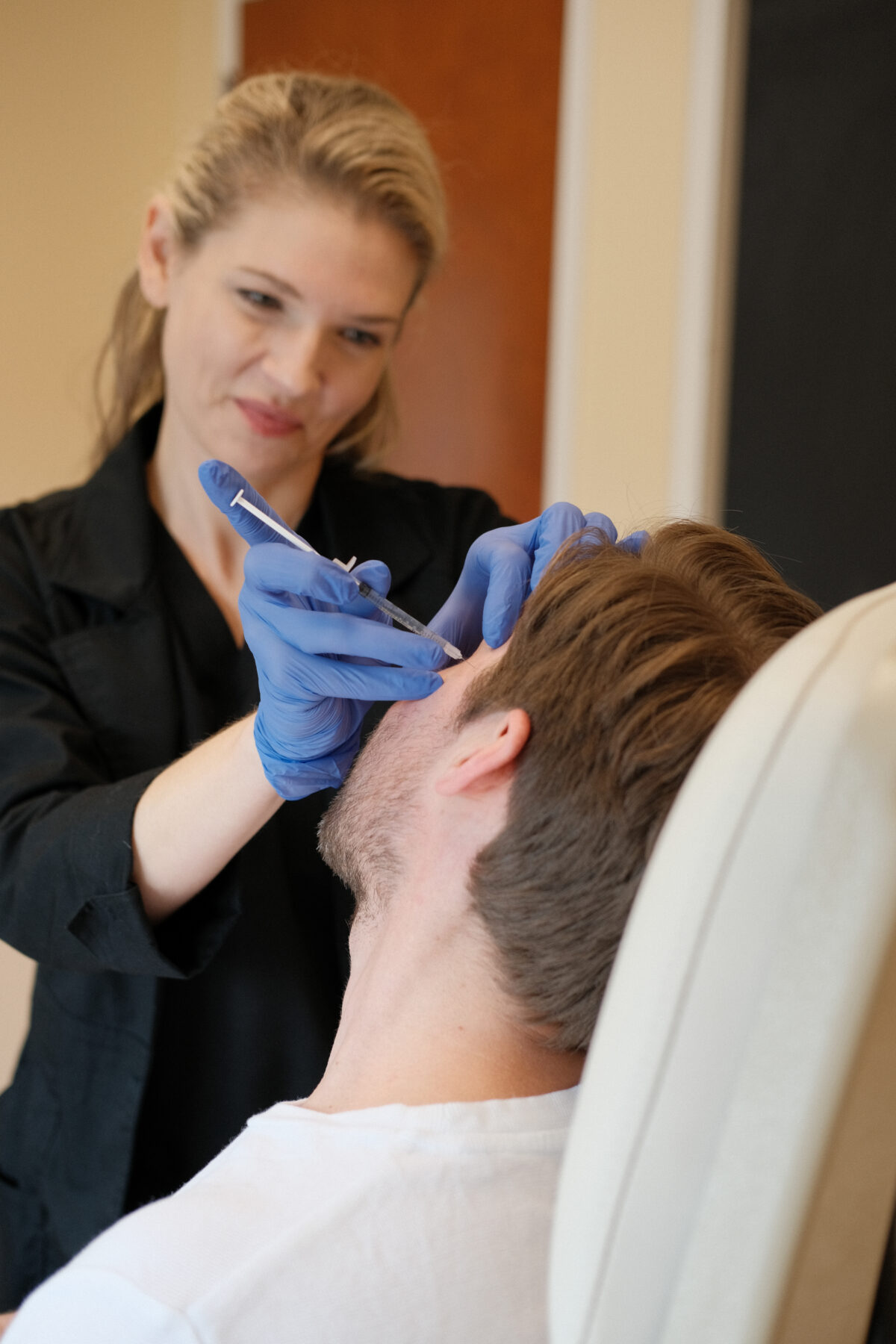
Biostimulator injectables — like calcium hydroxylapatite (Radiesse) — place a material into the skin that acts as a scaffold, prompting your fibroblasts to build new collagen around it over time.
Ultherapy takes an energy-based route with no injection at all. It uses microfocused ultrasound to gently heat precise points deep in the skin, creating tiny areas that switch on your body’s natural repair response. Histology studies show this prompts new collagen and — notably — new elastin, the fiber responsible for skin’s springiness, which not every treatment stimulates. Ultherapy is FDA-cleared for lifting and tightening the brow, neck, under-chin, and décolletage.
Because these approaches work differently, they’re sometimes used together — but neither one replaces the foundation below.
The foundation nobody should skip
Here’s the part the trend pieces tend to gloss over: the single most effective, best-proven collagen-protection strategy isn’t an injectable at all. It’s daily sun protection and a solid skincare routine. The American Academy of Dermatology points to daily sun protection as a cornerstone of preventing premature aging, and ingredients like retinoids and vitamin C have real evidence behind them.
If your skin is holding up well, a great SPF and a consistent home regimen may be the smartest “banking” plan for now. Biostimulators are a layer you can add on top of those habits — never a replacement for them.
So should you start?
Maybe — but it should be a personalized decision, not a reaction to a trend or a fear of aging. A thoughtful approach is conservative: the right foundation first, then a measured discussion about whether a biostimulator makes sense for your skin, your age, and your goals. There’s no prize for starting earliest, and the best plan is the one built specifically for you.
A fair note on the science: “Collagen banking” is a consumer term, not an official clinical claim from any manufacturer — the real, supported science underneath it is that these treatments stimulate collagen (and, with Ultherapy, elastin). Using biostimulators or Ultherapy purely preventatively in younger skin extends that mechanism beyond their specific FDA-cleared uses (which center on lifting, tightening, and correction). The rationale is reasonable, but long-term preventative outcomes are still being studied. This is a personalized clinical decision, not a guaranteed result — and it’s one we’re happy to talk through honestly.
The takeaway
Collagen banking isn’t a gimmick, but it isn’t a miracle either. Treat it as what it is: a sensible, preventative mindset that starts with sunscreen and skincare, and may include a well-chosen biostimulator when the timing is right for you. We’d rather give you that honest framing than sell you a trend.
Frequently asked questions
At what age should I start collagen banking?
There’s no single “right” age. Many people begin thinking about it in their late 20s to 40s, but the honest answer is that it depends on your skin, habits, and goals. The foundation — sun protection and skincare — is worth starting at any age; injectables are a personalized decision.
Does collagen banking really work?
The rationale is sound: collagen declines with age, and biostimulators can prompt new collagen production. But no treatment “stores” youth for later, and long-term preventative outcomes are still being studied. It’s best viewed as proactive maintenance, not a guarantee.
Is preventative Botox the same as collagen banking?
Not quite. Preventative neurotoxin aims to soften expression lines before they set in, while collagen banking focuses on supporting the skin’s structural collagen. They’re different tools that can be part of the same overall preventative plan.
Does Ultherapy help with collagen banking?
Ultherapy stimulates new collagen and elastin using microfocused ultrasound — a legitimate, well-studied mechanism — so it fits the collagen-banking idea of supporting your skin’s own production. It’s FDA-cleared for lifting and tightening; its use as a purely preventative tool is a personalized decision, and results build gradually over months.
Want an honest, no-pressure conversation about whether preventative treatment makes sense for you? That’s exactly what a consultation is for.