
Biostimulator vs. Regenerative: They’re Not the Same Thing
Medically reviewed by Sarah Long, DNP, APRN, FNP-BC — Clinical Lead, medAge • Updated May 2026
“Biostimulator.” “Regenerative.” “Collagen-building.” These words get used interchangeably in aesthetics marketing — but they don’t all mean the same thing. Understanding the difference will make you a sharper consumer, and it explains why we’re particular about the products we use.
This is a short, useful distinction that almost no clinic bothers to explain. Once you have it, a lot of the marketing you see online becomes easier to read.
What “biostimulation” actually means
Biostimulation simply means prompting your body to produce more of a specific biological building block — most often collagen. A biostimulatory treatment doesn’t just sit there adding volume; it signals your cells to get to work making something.
That’s genuinely valuable. But notice how narrow the definition is: stimulate the production of one component. By itself, that doesn’t say anything about whether the tissue is truly rebuilt or restored to how it functioned when it was younger. Stimulating collagen is a piece of the puzzle — not the whole picture.
What “regeneration” means — and why it’s a higher bar
Regeneration is a bigger idea borrowed from regenerative medicine. It means the actual repair and restoration of tissue so that it regains not just its structure but its function — behaving like healthy, younger tissue again.
Here’s the key logic, and it’s worth reading twice: something can be biostimulatory without being regenerative, but anything regenerative is, by definition, also biostimulatory. Stimulating collagen is one ingredient. Regeneration is the finished dish — collagen plus the other structures that make skin behave the way it did years ago.
Your skin is more than collagen
To understand why the distinction matters, it helps to know what actually gives youthful skin its quality. It isn’t collagen alone. Skin’s support system — the extracellular matrix — is a whole ecosystem:
As skin ages, all of these decline together — not just collagen. So a treatment that only nudges collagen is addressing one part of a much larger system. True regeneration means rebuilding across the ecosystem.
Where this lands for the products we use
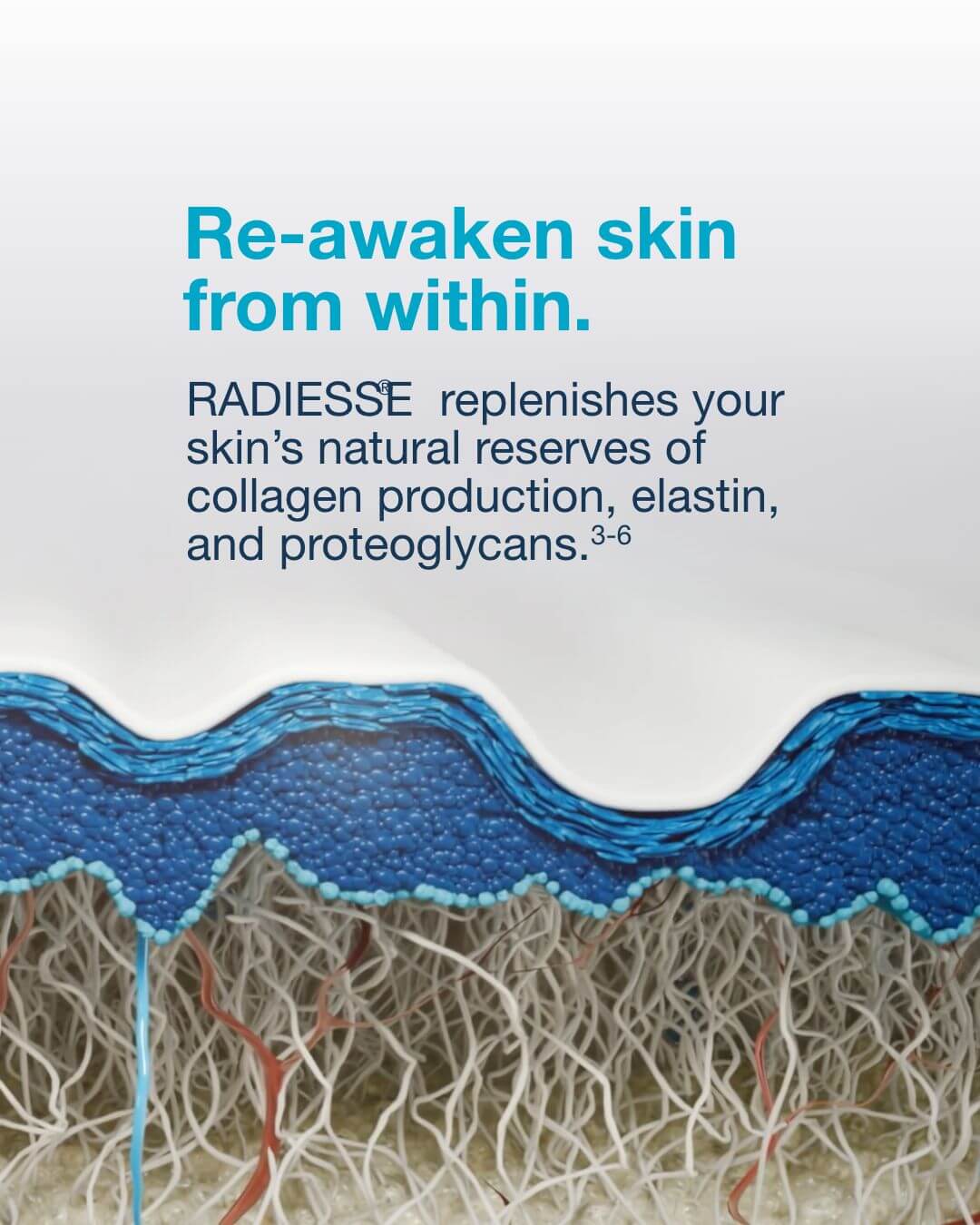
This is exactly why we favor calcium hydroxylapatite (Radiesse) as a biostimulant. In peer-reviewed literature, Radiesse has been shown to do more than stimulate collagen — it acts as a scaffold that prompts increases in collagen, elastin, proteoglycans, blood vessels, and the fibroblast cells that build all of it. In other words, it works across that whole ecosystem, which is why it’s increasingly discussed under the banner of “regenerative aesthetics” rather than simply “a collagen stimulator.”
That’s not a knock on other biostimulators — many are excellent at what they do. It’s a distinction about scope: stimulating one component versus restoring the broader matrix. When the goal is genuine skin-quality improvement and not just a temporary plump, that broader scope is what we’re after.
A fair note on the science: “Regenerative aesthetics” is an emerging and still-developing field. Much of the supporting work consists of expert reviews and smaller studies rather than large long-term trials, and results vary from person to person. We find the evidence compelling and use it to guide our choices — not as a guarantee of any specific outcome.
The takeaway
When you see a treatment marketed as “collagen-building,” it’s fair to ask a follow-up: is it just stimulating collagen, or is it helping restore the whole support structure of your skin? That single question separates a lot of the noise from the substance — and it’s the kind of thing we’re always happy to walk through with you in person.
Frequently asked questions
What is a biostimulator?
A biostimulator is a treatment that prompts your body to produce more of a biological building block — usually collagen — rather than simply adding volume. Radiesse and Sculptra are two of the best-known injectable biostimulators.
Is Radiesse regenerative or just a biostimulator?
Peer-reviewed literature describes Radiesse as doing more than stimulating collagen — it prompts increases in collagen, elastin, proteoglycans, blood vessels, and fibroblasts, which is why it’s increasingly discussed within “regenerative aesthetics.” The field is still developing, so results vary by person.
What is regenerative aesthetics?
It’s an emerging approach that aims to restore youthful skin structure and function using the body’s own repair systems, rather than only filling lines. It’s a growing area of research, though much of the evidence is still early.
Want to understand which approach fits your skin and your goals? Let’s talk it through at a complimentary consultation.