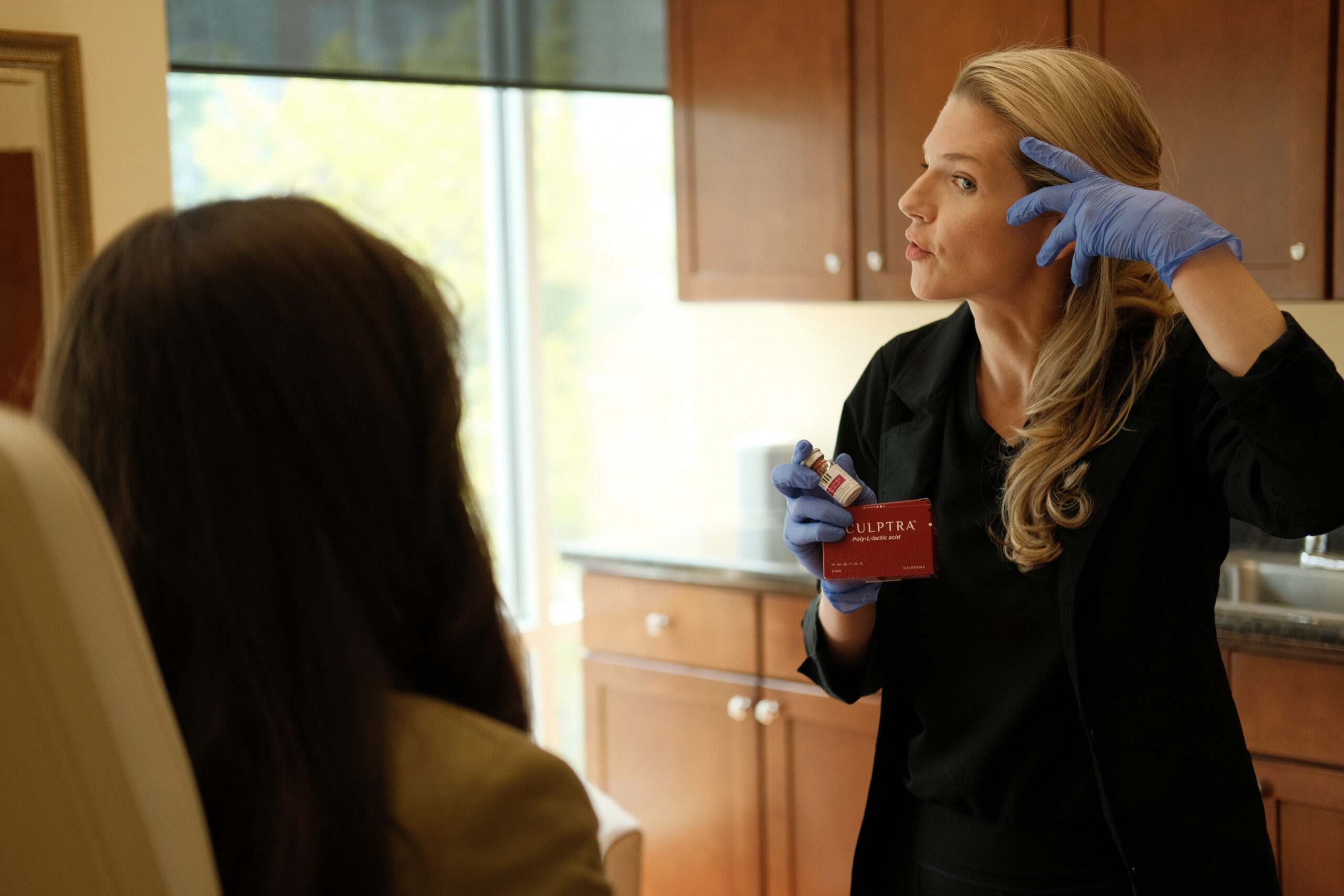
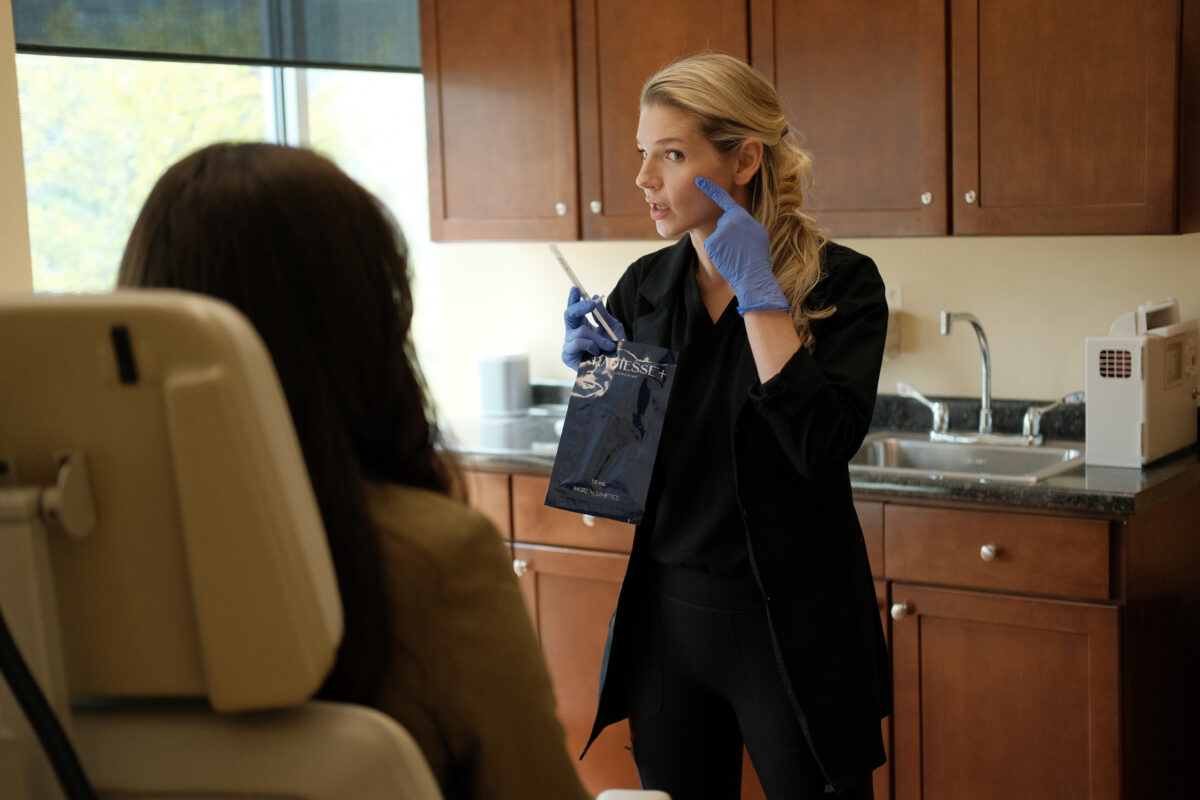
Radiesse vs. Sculptra: Why We Reach for a True Biostimulant
Medically reviewed by Sarah Long, DNP, APRN, FNP-BC — Clinical Lead, medAge • Updated April 2026
Radiesse and Sculptra get grouped together online as “the collagen-building injectables” — as if they’re interchangeable. They aren’t. They’re built from different materials, they work through completely different biology, and that difference is exactly why we prefer one of them for most patients.
If you’ve been researching biostimulators in Asheville, you’ve probably run into a lot of confident-sounding, contradictory information. Here’s the clear version, grounded in what the science actually shows.
First — what is a “biostimulator,” and how is it different from regular filler?
Most fillers you’ve heard of are made from hyaluronic acid (HA) — think Juvéderm and Restylane. They add volume immediately by holding water where they’re placed, and your body gradually breaks them down over months.
Biostimulators work differently. Instead of just filling a space, they prompt your own skin to build new structural tissue — collagen and elastin — over time. The result develops more gradually and is about improving the quality and firmness of the skin itself, not just plumping a line. Radiesse and Sculptra are the two best-known injectable biostimulators. That’s where the similarity ends.
Radiesse: calcium microspheres that work by contact
Radiesse is made of calcium hydroxylapatite (CaHA) — tiny, smooth, perfectly round microspheres suspended in a gel. Calcium hydroxylapatite is a substance your body already recognizes; it’s a mineral found naturally in bone.
Here’s the part that matters. Under a microscope, Radiesse particles are uniform and spherical, mostly 20–45 microns across. When placed in the skin, they act as a physical scaffold that your fibroblasts — the cells responsible for making collagen — grab onto directly. That direct mechanical contact switches the fibroblasts “on” and prompts them to produce fresh collagen and elastin. Scientists call this mechanotransduction. In plain terms: Radiesse regenerates by touch, not by irritation.
Because the process doesn’t primarily rely on provoking an immune reaction, the results tend to be predictable — and the calcium microspheres are gradually resorbed over roughly a year or so, while the new collagen they helped build remains.
Sculptra: poly-L-lactic acid that works by inflammation
Sculptra is made of poly-L-lactic acid (PLLA), a synthetic material. Under the same microscope, PLLA looks nothing like Radiesse — it appears as irregular flakes of widely varying size and shape (roughly 2 to 150 microns). A published morphology study found Radiesse’s particles were significantly rounder and more uniform, while Sculptra’s contained a higher proportion of very small, irregular fragments.
That shape difference drives a biology difference. Sculptra builds collagen by triggering a controlled, sustained inflammatory response — your immune system reacts to the particles over time, and collagen forms as part of that healing cascade. It works, and many patients are happy with it. But because it runs through your immune system, the response can be less predictable from person to person, and it typically requires a series of sessions spaced weeks apart before results show.
The honest comparison
| Factor | Radiesse (CaHA) | Sculptra (PLLA) |
|---|---|---|
| Core material | Calcium hydroxylapatite microspheres | Poly-L-lactic acid |
| Particle shape | Smooth, round, uniform | Irregular flakes, varied sizes |
| How it builds collagen | Direct fibroblast contact (mechanotransduction) | Sustained inflammatory response |
| Immediate result | Yes — provides lift/contour right away | No — develops gradually |
| Relies on immune response | Minimal — works by direct contact | Yes — central to how it works |
| Sessions typically needed | Often fewer | Usually a series (commonly 3) |
So why do we favor Radiesse?
Three reasons, and they all come back to the same idea — predictability. Radiesse gives an immediate contour result and a long-term regenerative one, so patients see something on day one and keep improving for months. Its mechanism doesn’t rely on how strongly a given person’s immune system reacts, which makes outcomes more consistent chair to chair. And it’s remarkably versatile: by adjusting how it’s diluted, the same product can be used for structured lift along the jawline and cheeks, or spread thin to improve skin quality and crepiness on areas like the neck, chest, and hands.
None of this makes Sculptra a bad product — it’s FDA-approved and effective in the right hands. It simply means that for the way we practice, and for what most of our patients are after, Radiesse’s contact-based, immune-independent regeneration is the tool we reach for first.
A note on how we use it: Radiesse is FDA-approved for specific facial and hand indications. Some of the skin-quality and diluted “skin tightening” applications described here are used at the discretion of your provider. Everything is decided in consultation, based on your anatomy and goals — not a script.
Which one is right for you?
That depends on what you’re trying to change — volume and contour, skin quality, or both — and on your own skin and health history. The best answer doesn’t come from a blog; it comes from an exam. What we can promise is that we’ll walk you through the actual reasoning, not just hand you a menu.
Frequently asked questions
Is Radiesse better than Sculptra?
Neither is universally “better” — they’re built for different jobs. We tend to prefer Radiesse because it delivers an immediate contour result plus immune-independent collagen regeneration, which makes outcomes predictable. Sculptra is FDA-approved and effective too. The right choice depends on your goals and skin, decided at consultation.
How long does Radiesse last?
Results commonly last around a year or more, though it varies by treatment area, how the product is diluted, and the individual. The calcium microspheres are gradually resorbed over roughly a year, while the new collagen they helped stimulate can persist beyond that.
Does Radiesse actually build collagen?
Yes. Its smooth calcium microspheres act as a scaffold that fibroblasts grab onto directly, prompting your own skin to produce new collagen and elastin — a process supported in peer-reviewed literature.
Curious whether Radiesse is right for your skin? Our providers will give you a straight answer at a complimentary consultation.